
Broad Market Indexes
A broad equity market index, as its name suggests, represents an entire given equity market and typically includes securities representing more than 90 percent of the selected market.
Multi-Market Indexes
Multi-market indexes usually comprise indexes from different countries and regions and are designed to represent multiple security markets.
Multi-market indexes may represent multiple national markets, geographic regions, economic development groups, and, in some cases, the entire world. World indexes are of importance to investors who take a global approach to equity investing without any particular bias toward a particular country or region. A number of index providers publish families of multi-market equity indexes.
Fundamental Weighting in Multi-Market Indexes
Some index providers weight the securities within each country/region by market capitalisation and then weight each country/region in the overall index in proportion to its relative GDP, effectively creating fundamental weighting in multi-market indexes.
Sector Indexes
Sector indexes represent and track different economic sectors — such as consumer goods, eneergy, finance, health care, and technology — on either a national, regional, or global basis.
Style Indexes
Style indexes represent groups of securities classified according to market capitalisation, value, growth, or a combination of these characteristics. They are intended to reflect the investing styles of certain investors, such as the growth investor, value investor, and small-cap investor.
Market Capitalisation
Market-capitalisation indexes represent securities categorised according to the major capitalisation categories: large cap, midcap, and small cap. With no universal definition of these categories, the indexes differ on the distinctions between large cap and midcap and between midcap and small cap, as well as the minimum market-capitalisation size required to be included in a small-cap index.
Value/Growth Classification
Some indexes represent categories of stocks based on their classifications as either value or growth stocks. Different index providers use different factors and valuation ratios (low price-to-book ratios, low price-to-earnings ratios, high dividend yields, etc.) to distinguish between value and growth equities.
Market Capitalisation and Value/Growth Classification
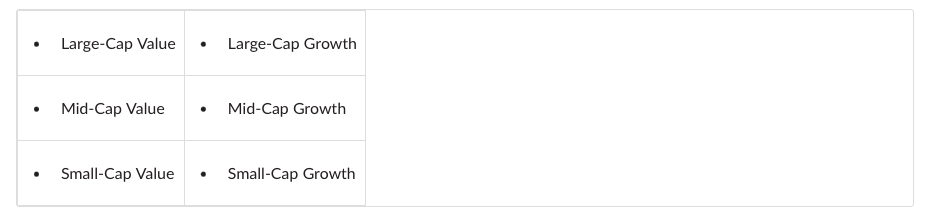
Combining the three market-capitalisation groups with value and growth classifications results in six basic style index categories: